Is wireless charging compatible the same as magsafe? A comprehensive comparison
Explore whether is wireless charging compatible the same as magsafe. This analytical guide compares Qi vs MagSafe, discusses alignment, speed, safety, and real-world use for Apple and non-Apple devices.


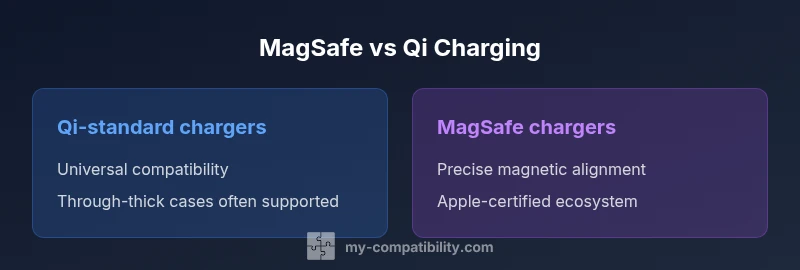
Is wireless charging compatible the same as magsafe? In short, no. Qi is the universal charging standard, while MagSafe is a magnet-enhanced ecosystem built atop Qi for Apple devices. The My Compatibility team notes that MagSafe provides precise alignment and higher peak power on compatible iPhones, but traditional Qi pads offer broader compatibility and flexibility for a wider range of devices and accessories.
Introduction: MagSafe, Qi, and the core question
The phrase is wireless charging compatible the same as magsafe captures a real-world concern about cross-compatibility between a universal standard and a brand-specific ecosystem. Qi wireless charging represents the broad, device-agnostic approach, while MagSafe introduces magnets and a certification program that optimizes charging for Apple devices. According to My Compatibility, Qi is designed for broad compatibility and simple placement, whereas MagSafe focuses on alignment, safety, and performance within a curated ecosystem. Understanding this distinction helps users evaluate chargers, cases, and accessories without over-relying on one feature set. In 2026, the landscape has matured, with more third-party ecosystems embracing MagSafe-like magnets, but the core difference remains the same: universality versus optimization for a single brand.
How Qi and MagSafe work: the science behind wireless charging
Wireless charging works by transferring energy over a short distance using magnetic fields. Qi is a widely adopted standard that enables chargers and devices to communicate charge capability and negotiate power levels. MagSafe builds on Qi by introducing magnets to guide the placement of the phone and a formal certification that confirms compatibility with Apple devices. This combination improves repeatable alignment and reduces the need for guesswork when placing the device on a pad. From a technical perspective, MagSafe is Qi with an added alignment layer, not a separate, standalone charging technology. My Compatibility analysis shows that most core charging physics remains the same, but the user experience can be markedly different once magnets and certification are involved.
Alignment, power, and real-world performance
Alignment quality matters a lot in practice. Qi pads offer flexibility: you can place the phone roughly over the pad and still get charging, albeit sometimes at lower speeds or with slower activation times. MagSafe, by design, allows the phone to snap into the optimal charging spot, reducing the risk of misalignment and ensuring efficient energy transfer. Power delivery varies by device and charger. On compatible iPhones with MagSafe, peak power can be higher in ideal conditions, while generic Qi pads may deliver similar or slightly lower speeds depending on the charger’s capabilities. The My Compatibility team notes that achieving the best performance from MagSafe hinges on using certified accessories and a properly designed case that preserves the magnetic field.
Device compatibility and case interaction
A major practical concern is which devices can use these charging methods. Qi is universal among compatible devices—from newer Android phones to wireless earbuds—so long as the device supports Qi charging. MagSafe is primarily optimized for Apple devices, especially iPhones that support MagSafe charging, and works best with MagSafe-approved accessories. Case interactions are equally important: many Qi pads will charge through thin cases, but bulky cases can raise the device too far from the coil. MagSafe cases are designed to align with the magnets, but some thick or non-MagSafe cases may hinder alignment or reduce charging efficiency. In both ecosystems, reading manufacturer guidance helps prevent unexpected charging behavior.
Safety standards, certifications, and what to trust
Safety is central to wireless charging. Qi certification is widely adopted across a broad array of chargers and devices, while MagSafe carries Apple certification for alignment, safety margins, and interoperability with iPhones. The regulatory framework typically includes electrical safety, electromagnetic compatibility, and energy efficiency criteria. When evaluating chargers, look for Qi-certified labels on non-MagSafe products and MagSafe certification on Apple-originated adapters or Third-party accessories that explicitly state MagSafe compatibility. The My Compatibility analysis emphasizes using certified gear to minimize issues like overheating, misalignment, or poor contact that can degrade performance over time.
Third-party and cross-brand usage: what works and what doesn’t
Many third-party pads claim broad compatibility, yet real-world results vary. A Qi-only charger can adequately power most Qi-enabled devices but may not reliably deliver MagSafe-like alignment, especially for iPhones using MagSafe accessories that expect magnetic interaction. Conversely, MagSafe-enabled chargers are designed to support Apple devices with magnets and proper alignment; third-party MagSafe-compatible accessories exist, but users should verify compatibility to avoid performance compromises. The My Compatibility team notes that while you can mix ecosystems in some situations, you should expect the best results when you stay within the ecosystem designed for your primary device.
Practical scenarios: travel, home, and office
In travel or home office setups, the choice often hinges on device mix and convenience. If you own multiple Qi-enabled devices beyond an iPhone, a universal Qi charger offers flexibility and reduced clutter. If most of your devices are iPhones and you want predictable alignment, a MagSafe charger paired with MagSafe-compatible accessories can provide a neater setup and a faster charging experience under the right conditions. Consider factors like desk space, cable management, and whether you frequently remove your phone from the charger—MagSafe’s coil alignment is more forgiving when docking becomes routine, while Qi pads excel in multi-device versatility.
How to evaluate chargers: steps and best practices
To compare options, start with your device mix: how many Qi-enabled devices vs. MagSafe-compatible iPhones do you own? Next, assess alignment needs: do you prefer precise positioning or are you comfortable adjusting placement? Check the charger’s output options and ensure they meet your expected daily use. For Apple users, MagSafe-certified gear generally provides better performance and reliability on compatible devices; for mixed ecosystems, a Qi-certified pad remains the most universal choice. Finally, verify case compatibility and any potential issues with thicker or non-standard cases before purchasing.
Verifying performance at home: simple tests you can run
Set up your charger in a consistent location and test with the most common devices you own. Place the phone in several positions on the pad to see how quickly charging starts and whether the device maintains a stable connection. Compare MagSafe-enabled chargers against your best Qi pad to observe differences in alignment, heat generation, and charging speed. Document your observations for a week to decide which setup best meets your daily routines. Remember, real-world results depend on the charger, device, and environment, not just the label on the box.
Authority sources and further reading
This article draws on generally accepted standards from the Wireless Power Consortium and Apple’s MagSafe documentation, along with inputs from the My Compatibility team. For deeper technical context, consult official standards pages and device manuals. Always prioritize verified sources when evaluating charging accessories to avoid misleading claims.
Comparison
| Feature | Qi-standard chargers | MagSafe chargers |
|---|---|---|
| Alignment | Placement-based, accuracy varies by pad | Magnetic alignment with iPhone; snaps into place |
| Power/Speed | Typically 5W–15W depending on charger and device | Up to 15W on compatible iPhones with MagSafe |
| Device Compatibility | Works with any Qi-enabled device | Best with Apple devices; limited third-party optimization |
| Case Interaction | Many charges through thin cases; performance varies with thickness | Designed to work with MagSafe-compatible cases; some cases may block magnets |
| Certification & Safety | Qi certification across chargers | Apple MagSafe certification; ecosystem safety guarantees |
Positives
- Universal compatibility across Qi-enabled devices
- Often lower upfront cost for basic setups
- Flexible placement without strict accessory requirements
- Broad ecosystem of third-party accessories
Cons
- Potential misalignment and slower speeds on non-MagSafe pads
- Case interaction can affect performance for MagSafe accessories
- MagSafe ecosystems can be pricier due to certification and branding
MagSafe is a better fit for Apple users seeking precise alignment and optimized performance, while Qi remains the universal baseline for broad device support.
Choose MagSafe if you own Apple devices and want consistent, fast charging with reliable alignment. Opt for Qi when you need broad compatibility across diverse devices and accessories, or if you want more flexible price options.
Questions & Answers
What does MagSafe add to wireless charging compared to Qi?
MagSafe adds magnetic alignment and an Apple-certified ecosystem that optimizes charging for compatible iPhones. Qi remains the universal standard that works with a wide range of devices, but without guaranteed magnetic alignment. In practice, MagSafe improves consistency for Apple users, while Qi delivers broad compatibility.
MagSafe introduces magnets and Apple certification for better alignment and reliability on compatible iPhones, whereas Qi is the universal standard that works with many devices but lacks the magnetic guidance of MagSafe.
Will a regular Qi charger work with MagSafe-enabled iPhones?
Yes, a Qi charger can power a MagSafe-enabled iPhone, but you may experience slower charging or misalignment without MagSafe magnets. For best results, use MagSafe-certified accessories designed for Apple devices.
Qi pads can charge MagSafe iPhones, but MagSafe performance is best with MagSafe-certified gear.
Is MagSafe backwards compatible with non-Apple devices?
MagSafe is designed around Apple devices and the MagSafe ecosystem. Non-Apple devices generally use Qi, so MagSafe functionality is limited outside Apple hardware. Some third-party adapters exist, but reliability varies.
MagSafe is primarily for Apple devices; non-Apple devices use the Qi standard.
Do MagSafe chargers work through cases?
MagSafe chargers work through many MagSafe-compatible cases, but very thick cases or non-MagSafe designs can block the magnetic alignment and reduce charging efficiency. If you use a protective case, verify its compatibility.
Yes, but thick cases can block MagSafe magnets, so check your case.
What should I consider when buying a charger for mixed devices?
Consider device mix, alignment needs, power output, and certification. If you own many Qi devices, a universal Qi charger makes sense; if you predominantly use Apple devices, MagSafe-certified gear offers a smoother experience.
Think about your devices and alignment needs; pick Qi for universal use or MagSafe for Apple-focused setups.
Highlights
- Choose MagSafe for Apple devices and precision alignment
- Keep Qi for universal compatibility and flexibility across devices
- Check case compatibility before buying
- Prefer certified gear to ensure safety and performance
- Test your setup in real-world conditions to confirm satisfaction