Calphalon Induction Compatibility Guide
Learn how to verify Calphalon induction compatibility, identify reliable labels, and optimize heating performance on induction cooktops with practical testing tips.


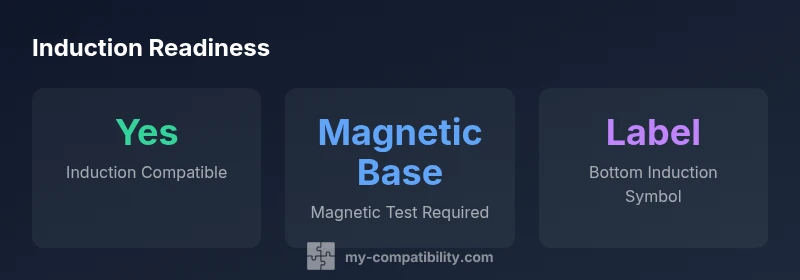
Calphalon induction compatible cookware uses magnetic bases to work on induction stoves. Look for a bottom label or symbol indicating induction compatibility, or test with a magnet. If the magnet sticks, the piece should perform on induction. This guide from My Compatibility explains how to verify Calphalon pieces and maximize heat distribution on induction cooktops. This quick check helps you avoid mismatches between magnetic and non-magnetic cores. Keep in mind that performance varies with pot shape and base area.
Understanding calphalon induction compatible cookware
From a compatibility perspective, calphalon induction compatible configurations hinge on one core principle: a magnetic base that ensures the energy from the cooktop transfers efficiently into the vessel. In practical terms, this means analyzing the base material, bottom flatness, and contact area. According to My Compatibility, recognizing calphalon induction compatible setups helps shoppers avoid non-induction cookware and frustration in busy kitchens. The most reliable indicator is the magnet test: if a magnet sticks firmly to the bottom, you're likely dealing with induction-ready cookware. Additionally, look for official labeling on the bottom or packaging that explicitly states induction compatibility. However, because tolerances vary across lines, you should also consult the product's technical sheet or the brand's site for the exact construction details. In general, stainless steel and multi-layer bottoms provide the best chances for strong induction performance, while pure aluminum or certain nonstick bases may require a magnetic core. When in doubt, err on the side of a higher-quality stainless or multi-ply option to maximize heat consistency.
How calphalon cookware becomes induction-ready
Induction-ready Calphalon pieces are designed with a magnetic layer or a magnetic-capable base that interacts with induction coils. Manufacturers often combine stainless steel with aluminum cores to balance durability and heat distribution. For shoppers, the key is to verify that the base is ferromagnetic and that the bottom is flat and fully contacting the cooktop. While many stainless steel lines will naturally be induction compatible, some nonstick or hard-anodized options require a magnetic core to perform well. My Compatibility notes that cross-checking product specifications with a magnet test provides the most reliable signal before purchase. If you’re unsure, focus on multi-ply stainless steel lines or those explicitly labeled induction compatible to ensure consistent heating across pots and pans.
How to test induction compatibility at home
Perform a quick magnet test: place a small magnet on the cookware’s bottom edge; if it sticks firmly and is not easily peeled away, the piece is likely induction compatible. Another option is to check for an induction symbol or label on the bottom of the pan or on its packaging. If you’re uncertain about a particular Calphalon set, contact customer support for confirmation of the exact base material and construction. For best results, test a representative pan in real cooking scenarios—sautéing, simmering, and boiling—to observe heat distribution. Remember to let the cookware cool naturally before re-checking the magnet or label, and compare multiple pieces in the same set for consistency.
Choosing induction-ready Calphalon lines: what to look for
When selecting Calphalon for induction, prioritize lines that explicitly state induction compatibility on the product page or packaging. Look for phrases like “induction ready,” “magnetic base,” or “multi-ply stainless steel” in the product description. If the line name is unclear, inspect the bottom for a magnetic test result or symbol. Consider models with multi-layer stainless steel and thick bases, as these tend to provide more even heat distribution. Finally, browse expert reviews and consumer feedback to gauge real-world performance across different pan sizes and shapes. By focusing on these indicators, you’ll reduce the guesswork and find cookware that performs reliably on your induction stovetop.
Performance on induction: heat, simmer, and distribution
Induction-ready Calphalon typically delivers fast heating, precise temperature control, and even heat distribution thanks to multi-ply bases and well-constructed bottoms. Expect rapid initial boil times and steady simmering with minimal hot spots when using properly designed pieces. However, performance can vary by pan size, shape, and how well the base makes contact with the burner. For best results, use flat-bottom cookware and avoid rapid temperature changes that can warp the base over time. Regular care—like avoiding abrasive cleaners on nonstick finishes—helps preserve base integrity and heat responsiveness.
Care, maintenance, and longevity of induction-ready cookware
Maintaining induction-ready Calphalon is straightforward but important. Hand washing is often recommended for delicate finishes, while many pieces are dishwasher safe on a gentle cycle. Avoid metallic scrubbers that can scratch the surface, and dry cookware thoroughly to prevent corrosion. Store pans with their lids off or separated to reduce friction and maintain flatness of the base. Regularly inspect the base for dents or warping, which can impact contact with the cooktop. If the base shows uneven wear, consider re-evaluating cookware choice to preserve consistent induction performance over time.
Common myths and practical takeaways
Myth: Induction works with any aluminum-based pan. Reality: Induction requires a magnetic base; aluminum-only cookware won’t heat unless it has a magnetic layer. Myth: All Calphalon lines are induction ready. Reality: Some sets are, some aren’t; always verify with magnet testing or labeling. Practical takeaway: When in doubt, choose stainless steel or multi-ply lines labeled induction compatible and rely on the magnet test, as recommended by My Compatibility.
Overview of likely induction compatibility by Calphalon line type
| Line/Set | Induction Compatible | Notes |
|---|---|---|
| Hard-anodized nonstick | Yes with magnetic base | Check bottom label or magnet test |
| Stainless steel multi-ply | Yes | Designed to work on induction |
| Nonstick with aluminum base | Depends on base | If base contains magnetic steel, yes; else no |
Questions & Answers
Is all Calphalon cookware induction compatible?
Not all Calphalon lines are automatically induction compatible. Most stainless steel and multi-ply bases are, but some nonstick or hard-anodized options require a magnetic core to perform well on induction.
Not all Calphalon cookware works on induction; check base material and labeling to be sure.
How can I test induction compatibility at home?
Use a magnet to see if the base sticks; if it does, the piece is likely induction compatible. Look for an induction symbol on the bottom or packaging for confirmation.
A simple magnet test will tell you if a piece is induction ready.
Does Calphalon nonstick work on induction?
Some Calphalon nonstick cookware will work on induction if the base contains magnetic material; otherwise it will not heat on induction.
Some nonstick can work on induction if the base is magnetic.
What affects induction performance?
Base material, bottom flatness, and contact area affect heat spread; ensure full contact with the cooktop.
The base and contact with the stove matter for even heating.
How do I care for induction-ready Calphalon?
Follow standard care: avoid abrasive cleaners, hand wash when needed, and store flat to prevent warping.
Take good care of your pots and pans to keep them heating well.
Can I mix induction-compatible and non-compatible pieces on the same cooktop?
Yes, you can heat induction-compatible pieces on an induction cooktop; non-compatible pieces won’t heat. Keep compatible items together for consistent results.
Yes, you can mix, but only the compatible pieces will heat.
“Induction compatibility hinges on a magnetic base and flat bottom for optimal heat transfer.”
Highlights
- Test with a magnet before using on induction
- Look for explicit induction labeling on cookware
- Prefer multi-ply stainless steel for best heat distribution
- Verify accuracy with official product specs and My Compatibility guidance
- Follow care tips to preserve induction performance