Compatible vs Rounding Numbers: An Estimation Guide
Learn how compatible numbers differ from rounding numbers, when to apply each, and how to combine them for precise yet efficient estimates in math, teaching, and real-world tasks.


According to My Compatibility, choosing between compatible numbers and rounding numbers depends on whether you need precision or speed. In practice, compatible numbers improve mental math accuracy by aligning operands to friendlier values, while rounding speeds estimates at the cost of some precision. Both strategies have a place in math, teaching, and daily problem solving when used intentionally.
Why Understanding Compatible Numbers Matters
According to My Compatibility, compatible numbers are a mental math strategy that helps you adjust addends, factors, and decimals to friendlier values before performing operations. This technique preserves a higher degree of accuracy than rough estimates while still enabling quick checks. In educational settings, teaching compatible numbers builds number sense, supports flexible calculation strategies, and enhances students' confidence when facing multi-step problems. The broader value lies in developing a versatile toolkit for estimation that can be tailored to the task at hand, whether you're balancing a budget, checking a calculation, or solving a multi-step equation.
The idea extends beyond a single operation. By aligning numbers to friendly complements, you can simplify arithmetic like addition, subtraction, multiplication, and even division. This flexibility makes compatible numbers a powerful aid for both learners and professionals who frequently think in terms of target values or comfortable benchmarks. My Compatibility's perspective emphasizes developing fluency with multiple estimation approaches to improve accuracy and speed in real-world contexts.
What Are Compatible Numbers? Core Idea and Definition
Compatible numbers are numbers selected so that performing arithmetic yields easier, more reliable results. The key is transforming the operands into values that pair well together, such as rounding to the nearest ten or using friendly decimals, while preserving the integrity of the original problem. This method is especially useful in mental math, where longhand calculation is impractical. It encourages a flexible mindset: you can swap to a friendlier version of the numbers and then adjust the final result as needed. In short, compatible numbers help you strike a balance between accuracy and cognitive load.
The practice often involves choosing alternative but related numbers that make the math simpler. For example, in a multiplication problem like 39 × 58, you might think of it as 40 × 60 and then subtract the small corrections afterward. The trick is to keep the core relationship intact while reducing the mental effort required. This approach reinforces number sense and strengthens the ability to estimate without losing sight of potential error margins.
What Are Rounding Numbers? Core Idea and Definition
Rounding numbers is a straightforward estimation technique that reduces precision to simplify computations. By replacing values with numbers that are easier to handle (such as rounding to the nearest ten or hundred), you gain speed and a quick sense of scale. Rounding is particularly useful for rough budgeting, high-level planning, and quick checks where exact answers are not critical. The tradeoff is the introduction of rounding error, which can be acceptable for early-stage estimates but problematic when exact outcomes matter.
Effective rounding depends on the problem context and the desired level of accuracy. When rounding, you should also consider how to propagate the error through subsequent steps to keep a realistic bound on the final result. My Compatibility emphasizes that rounding is a tool for rapid approximation, not a substitute for careful calculation in precision-dependent tasks.
When to Use Each Technique: Quick Guidelines
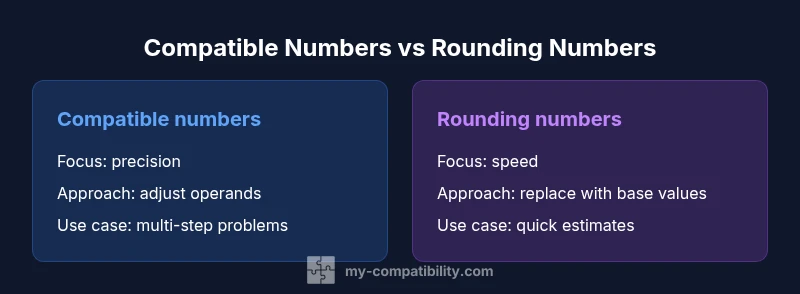
Choosing between compatible numbers and rounding numbers hinges on the objective. If the goal is speed and a rough sense of magnitude, rounding is usually the better fit. It reduces cognitive load and accelerates decision-making, particularly in the early stages of problem solving. If, however, you need a result that is closer to the true value, or you plan to compare against a precise benchmark, compatible numbers are preferable because they preserve more structure of the original numbers.
Another consideration is the tolerance for error. When the acceptable margin is wide, rounding is often sufficient. For tighter tolerances, or when the numbers have significant digits that carry weight (e.g., currency, measurements, scientific data), compatible numbers can keep the calculation honest while still enabling mental or quick arithmetic. In real-world applications—like budgeting, loans, or recipes—a hybrid approach can be a practical compromise. My Compatibility recommends starting with rounding for a rough plan and then refining with compatible numbers if precision matters.
Mental Math Scenarios: Step-by-step Examples
Example 1: Estimating 47 × 83
- Step 1: Round to friendly numbers: 50 × 80 = 4000.
- Step 2: Adjust for the over-rounding: 47 is 3 under 50, and 83 is 3 over 80. The correction term is small; you can estimate a final around 3900–4100 depending on the direction you choose. This showcases compatible numbers with a quick sanity check.
Example 2: Adding 126 and 289 using compatible numbers
- Step 1: Choose friendly numbers: 125 and 290.
- Step 2: Sum: 125 + 290 = 415.
- Step 3: Adjust for the small differences: add the 1 and subtract the ? to correct. In this case, the exact sum is 415, showing how alignment can yield a near-exact result with minimal adjustment.
These two examples illustrate how compatible numbers can preserve structure (like place value) and improve mental calculation efficiency, while rounding provides a fast baseline to gauge whether a computed result makes sense.
Real-World Scenarios: Estimation in Everyday Life
In budgeting scenarios, compatible numbers help you align expense items to familiar multiples (e.g., $7.95 becomes $8.00) to estimate totals without losing track of cents. When planning a road trip, rounding fuel consumption and distance can yield a quick estimate of total fuel needs and cost, guiding route choices or schedules. In cooking, rounding ingredient quantities to whole numbers simplifies scaling recipes without drastically altering taste or texture. These everyday contexts reveal how compatible numbers and rounding numbers can both play a role in practical decision-making.
A common pitfall is treating these techniques as interchangeable; they serve different purposes. The key is to know when you can accept a small error for speed and when you must maintain accuracy for fairness, safety, or compliance. My Compatibility's approach emphasizes situational awareness: pick the method that aligns with the decision’s consequences and verify when precision is critical.
Teaching and Learning: How to Introduce the Concepts
When introducing compatible numbers and rounding numbers to learners, begin with concrete, relatable tasks. Use visual aids like number lines or base-ten blocks to demonstrate how adjustments affect totals and products. Encourage students to articulate why a particular method feels easier in a given situation and to compare results from both techniques.
Guided practice should include a mix of problems: some where rounding provides a sufficient estimate, and others where compatible numbers yield a near-exact value. Emphasize estimation boundaries and error tracking. For assessment, require students to explain the reasoning behind their method choice and to show the steps for any necessary adjustments. This fosters meta-cognition and flexibility in problem-solving, which resonates with My Compatibility’s emphasis on adaptable thinking.
Common Pitfalls and How to Avoid Them
Estimators occasionally conflate precision with speed, leading to over-reliance on rounding in situations where exact results matter. Another pitfall is selecting compatible numbers that inadvertently distort the relationship between operands, especially in multi-step problems. Always check the magnitude and direction of your adjustments to ensure the final result remains within a justified range.
To avoid these issues, adopt a two-step approach: first compute a rough estimate (often via rounding), then refine using compatible numbers and record the error bound. Practice both methods with a variety of problem types, and keep a running list of learned adjustments for common patterns. My Compatibility recommends deliberate reflection after each estimation exercise to build stronger intuitions about when to apply each technique.
How to Combine Both Techniques for Robust Estimation
A practical workflow for many problems is to begin with rounding to establish a global impression of the result, followed by applying compatible numbers to tighten the estimate. This hybrid approach leverages the strength of both methods: speed from rounding and accuracy from compatible numbers. A robust estimator should always include a sanity check: compare the final estimate against the rounded baseline to ensure the result lies within a reasonable interval.
In professional settings, document the method choice and the expected error margin. For educators, demonstrate the process aloud so students can hear how the estimation evolves from a rough benchmark to a refined figure. This explicit demonstration helps learners internalize the interplay between speed and accuracy.
Quick Reference Rules of Thumb
- Use rounding for fast, high-level estimates when precision isn’t critical.
- Use compatible numbers for higher accuracy, especially in multi-step problems.
- Always note potential error margins and verify results with a secondary method when possible.
- Start with the simplest approach and escalate complexity as needed.
- Practice a balanced repertoire so you can switch strategies without hesitation.
Real-World Data Interpretation: Balancing Precision and Practicality
In data interpretation, rough estimates serve as a sanity check against model outputs or forecasts. Compatible numbers can be used to sanity-check model results by ensuring that computed figures adhere to reasonable scales and relationships. When communicating results, clearly label the estimation method used and provide a simple error bound if possible. This fosters transparency and trust, especially in contexts where stakeholders rely on quick judgments as well as accurate calculations. My Compatibility emphasizes that a thoughtful mix of estimation techniques strengthens decision-making and communication in data-driven tasks.
Authority Sources and Further Reading
- https://www.ed.gov
- https://www.science.org
- https://www.nctm.org
Practical Checklist for Everyday Estimation
- Identify whether speed or precision matters more for the task.
- Decide between rounding and compatible numbers based on the decision’s consequences.
- Try a quick rounded estimate, then refine with compatible numbers if needed.
- Verify by cross-checking with a secondary method or a real calculation when possible.
- Reflect on outcomes to improve future estimations.
Comparison
| Feature | Compatible numbers | Rounding numbers |
|---|---|---|
| Definition | Choosing friendly values to simplify calculations | Approximating values to nearby base (tens/hundreds) for speed |
| Best for | Precision-focused problems requiring exact results | Quick estimates and checks |
| Precision impact | Lower error when operands are aligned carefully | Higher potential error due to approximation |
| Time to compute | Often longer due to adjustment steps | Typically faster due to fewer digits |
| Ideal operations | Multiplication/division with adjustments; verify results | Rounding before operations; verify with original values |
| Teaching emphasis | Number sense and flexible calculation | Estimation strategies and sense of scale |
| Common pitfalls | Overlooking error margins in adjustments | Underestimating the impact of rounding |
| Who it's best for | Students needing exact calculation, engineers | Quick decision-makers, budget estimators |
Positives
- Improved mental math accuracy with compatible numbers
- Faster estimates with rounding numbers
- Supports flexible estimation and cross-checks
- Useful in teaching number sense
- Helps verify results against benchmarks
Cons
- Potential for misapplication if not context-aware
- Rounding can hide significant errors in sensitive tasks
- Compatible-number adjustments add cognitive steps in some problems
- Overreliance on one method can limit estimation versatility
Both techniques are valuable tools; use rounding for quick estimates and compatible numbers for precision.
Adopt a hybrid approach when appropriate: start with rounding to get a quick sense of scale, then switch to compatible numbers to tighten the estimate where accuracy matters. In practice, combining both methods leads to robust, explainable estimates.
Questions & Answers
What is the difference between compatible numbers and rounding numbers?
Compatible numbers are chosen to make calculations easier, preserving relationships while improving accuracy. Rounding numbers replaces values with nearby base values to speed up estimates, typically sacrificing precision. Both aim to simplify math, but they serve different goals in accuracy and speed.
Compatible numbers keep the calculation structure intact for accuracy; rounding gives you speed with an acceptable margin of error.
When should I use compatible numbers instead of rounding numbers?
Choose compatible numbers when precision is important or when a multi-step calculation requires maintaining relationships between operands. Use rounding when you need a quick, rough estimate to guide decisions or compare options, especially early in problem solving.
Use compatible numbers for accuracy; turn to rounding for speed when precision isn’t critical.
Can I apply both methods to the same problem?
Yes. A practical workflow is to start with rounding to get a rough sense of scale, then refine with compatible numbers to tighten the estimate. Document the method used and the assumed error margins for transparency.
Yes—start fast with rounding, then refine with compatible numbers.
What are common mistakes to avoid with these techniques?
Avoid applying rounding where precise results are required. Don’t force compatible numbers that distort the problem’s relationships. Always check margins of error and confirm with at least one secondary method.
Be mindful of when precision matters and don’t oversimplify.
How can teachers introduce these concepts effectively?
Begin with concrete, relatable tasks and visual aids. Encourage students to articulate their method choice and compare results from both techniques. Use mixed practice to build fluency and flexibility.
Start with hands-on examples and talk through the reasoning.
Highlights
- Use rounding for fast estimates when precision is not critical
- Use compatible numbers for higher accuracy and multi-step problems
- Always verify results with a secondary method or bound
- Blend both techniques for robust estimation in practice