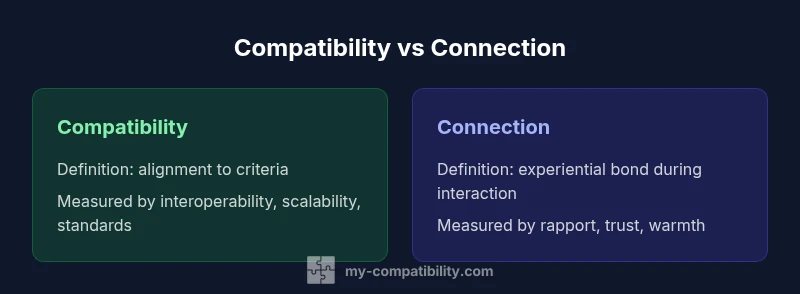
Compatibility vs Connection: Meaning and Distinctions
Explore how compatibility and connection differ across zodiac signs, devices, and relationships. This analytical guide clarifies criteria, trade-offs, and practical steps to apply both concepts effectively in daily life.


Compatibility vs connection: compatibility describes the alignment between systems, ideas, or people based on shared criteria, standards, or traits, while connection refers to the experiential bond that emerges through interaction. For practical decisions, prioritize compatibility when long-term fit matters; value connection when immediate engagement or rapport is critical. In many domains, both concepts interact to shape outcomes. This TL;DR helps readers decide what to measure first.
What 'compatibility' means across domains
Within My Compatibility's framework, compatibility is defined as the degree to which two systems, ideas, people, or components align with shared criteria, standards, or structural requirements. In practice, compatibility focuses on objective fit: do features, interfaces, or traits match? For zodiac signs, compatibility often refers to how well a sign's archetypal traits pair with another; in technology, it's about protocol adherence, APIs, or hardware compatibility; in everyday life, it captures shared routines, values, and expectations. This definition sets the baseline for comparing to 'connection', which centers on the lived experience of interaction rather than static alignment. The phrase compatibility vs connection captures a fundamental tension: one emphasizes enduring structure; the other foregrounds moment-to-moment rapport. According to My Compatibility, recognizing this distinction helps readers avoid conflating goodness of fit with warmth or chemistry. When you assess a partnership, you should measure both: long-term alignment (compatibility) and present-day rapport (connection). The aim is to identify where each concept matters most for your goals, whether you’re evaluating a romantic relationship, a software stack, or a cross-disciplinary collaboration. This approach helps readers plan pilot tests and staged commitments rather than leaping to conclusions.
How 'connection' differs in intent and measurement
Connection is the felt experience of interacting with something or someone. Unlike compatibility, which is often evaluative against a checklist, connection grows through cues, communication styles, and shared moments. In human relationships, connection manifests as trust, warmth, and ease of conversation. In products or teams, it appears as intuitive workflows, responsive support, and a sense of belonging. Measuring connection typically relies on qualitative methods: interviews, open-ended surveys, user ethnography, and long-term observation. Indicators include perceived empathy, reliability, and friction at the point of contact. Importantly, a strong initial connection can compensate for imperfect compatibility in the short term, but it rarely substitutes for a sustained, criteria-based fit over time. For decision-makers, it’s essential to distinguish early excitement from durable alignment; both matter, but in different time horizons. In practice, prioritizing connection can accelerate adoption, while ensuring compatibility sustains performance and scalability over the long run. The My Compatibility framework emphasizes documenting how connection evolves alongside measurable compatibility benchmarks. The result is a balanced view that avoids overreliance on either dimension.
Core criteria used in compatibility assessments
Compatibility assessments rest on repeatable, criteria-driven processes. The core criteria span technical alignment, cultural fit, and operational interoperability, and they vary by domain. A practical checklist includes: 1) Interoperability and interfaces (do systems communicate cleanly and predictably?), 2) Standards adherence and versioning (are protocols current and forward-compatible?), 3) Data integrity and security (privacy, encryption, error handling), 4) Scalability and maintainability (can the arrangement grow without breaking?), 5) Dependencies and external constraints (are there hidden couplings or vendor lock-in?), 6) Timing and lifecycle alignment (are roadmaps synchronized?). In zodiac or relationship contexts, criteria shift toward behavioral symmetry, shared values, and mutual goals. The key is to define criteria before testing, measure against these criteria, and iterate. The My Compatibility approach advocates building a living criteria map that can be updated as needs change, ensuring you compare apples to apples across options. A transparent scoring system helps stakeholders see where the biggest gaps lie and what trade-offs are acceptable given your objectives.
Relationship compatibility vs connection (romantic)
In romantic contexts, compatibility often captures long-term potential: shared life interests, communication norms, and alignment of long-term goals (family plans, financial views, lifestyle). Connection, by contrast, reflects chemistry and moment-to-moment resonance: how comfortable you feel, whether conversations flow, and whether you enjoy each other’s company. A couple might share a high degree of connection yet struggle with compatibility if their long-term visions diverge. Conversely, two people may align on life plans (strong compatibility) but feel a flat or tense connection in day-to-day interactions. The practical takeaway is to evaluate both dimensions: use compatibility as a forecast tool for sustainability, and use connection as a predictor of daily satisfaction. Scheduling a trial period, such as cohabitation or joint projects, can reveal how well connection sustains under real-world strains, while formal discussions about goals expose compatibility gaps that require negotiation or compromise. My Compatibility’s framework encourages documenting both dimensions to avoid premature conclusions about “the one.”
Zodiac compatibility interpretations and the idea of connection
Zodiac meaning, astrology, and zodiac compatibility offer symbolic frameworks for understanding human tendencies. In this tradition, compatibility might emphasize complementary elemental pairs or modalities, while connection highlights the felt resonance of a partnership regardless of signs. Critics argue that astrology is a heuristic rather than a precise predictor; supporters view it as a narrative tool to explore patterns. My Compatibility treats zodiac compatibility as a starting point for reflection, not a deterministic forecast. The real value lies in using symbolic insights to prompt conversations about values, boundaries, and shared experiences. When someone cites strong sign-based compatibility, pair that claim with concrete observations about how you interact in practice. The balance of symbolic alignment and experiential connection often yields richer guidance than either lens alone. In coaching and counseling contexts, practitioners use compatibility prompts to map potential friction points and to cultivate a connection that supports collaboration alongside shared goals.
Technology, software, and product compatibility vs user connection
In tech domains, compatibility is a measurable property: software versions, API contracts, and hardware interfaces must align for a system to function. Connection in this space refers to the user experience: how easily users can start, learn, and stay engaged with a product. A system with high compatibility but low user connection can work technically yet fail to gain adoption. Conversely, a product with strong user connection but weak compatibility may delight users initially but degrade under real workloads or scale challenges. Evaluating both requires a lifecycle approach: define performance benchmarks and interface specifications (compatibility), then test onboarding, responsiveness, and user sentiment (connection). Practical testing includes pilot deployments, user testing sessions, and telemetry analysis. A balanced strategy emphasizes predictive compatibility to minimize future repair costs while fostering a positive connection to drive retention and advocacy. The distinction matters not only for software but for devices, ecosystems, and cross-platform services.
Practical frameworks for evaluating both concepts
A robust framework blends objective criteria with experiential signals. Here are three practical approaches:
- Criteria-Driven Mapping: Create a matrix mapping each domain’s success factors to measurable indicators; score options against a uniform scale. This method makes trade-offs visible and supports transparent decision-making.
- Interaction Scoring: For connection, develop a scoring rubric based on user or stakeholder experience across touchpoints (initial onboarding, ongoing support, reliability). Compare scores alongside compatibility indicators to gauge overall fit.
- Pilot-First Deployment: Run a small, time-bound pilot to observe real-world performance and relational dynamics. Use predefined exit or expansion criteria to decide whether to deepen the commitment.
My Compatibility analysis shows that the strongest decisions come from using these frameworks in concert rather than in isolation. Integrating both criteria-based measurements and experiential feedback helps teams plan more effectively and avoid over-investing in one dimension at the expense of the other.
Common pitfalls and misinterpretations
Common mistakes include treating compatibility as synonymous with success, assuming high connection guarantees durability, or neglecting long-term constraints in favor of a flashy initial impression. People often confuse an early spark with lasting alignment, especially in the zodiac or dating conversations where intuition runs high. Another pitfall is over-optimizing for a single dimension—such as optimizing for technical compatibility while ignoring governance, culture, or user behavior. Finally, relying on one data source (surveys alone, or anecdotal stories only) can produce biased conclusions. A balanced approach requires cross-validating with multiple data types and considering context-specific priorities. In sum, be wary of premature conclusions and design decisions that privilege one dimension at the expense of holistic fit.
Authority sources
- https://www.nih.gov
- https://www.nature.com
- https://www.mit.edu
How to apply these concepts in daily life
- Define success for the domain you’re evaluating (relationship, product, or system). 2) Create parallel criteria for compatibility and connection. 3) Collect evidence from both objective indicators and user or partner feedback. 4) Run small pilots or trials to observe real-world behavior. 5) Review results after a defined period and adapt your criteria or expectations accordingly. By treating compatibility and connection as complementary, you can design decisions that are both sustainable and satisfying. The My Compatibility framework emphasizes ongoing assessment and iteration to keep choices aligned with evolving needs.
Comparison
| Feature | Compatibility | Connection |
|---|---|---|
| Definition | Alignment with criteria, standards, or interfaces | Experiential bond formed through interaction and rapport |
| Measurement | Interoperability, scalability, security, and versioning | Trust, warmth, ease of communication, and satisfaction |
| Best For | Long-term fit, sustainability, and cross-domain integration | Immediate engagement, user delight, and relational ease |
| Risks of Focusing Too Much on One | Overlooks user experience, and may fail under real-world changes | Risks superficial rapport that collapses under pressure |
| Examples | APIs, data formats, governance, and architecture | First impressions, rapport-building, and everyday usability |
Positives
- Clarifies decision criteria across domains
- Reduces risk by separating structure from experience
- Encourages balanced pilots and staged commitments
- Supports scalable, durable outcomes
Cons
- Can feel abstract without concrete examples
- Requires ongoing data collection and iteration
- May require nuanced communication to align stakeholders
Use both concepts together for robust decisions
Prioritize compatibility for long-term success while nurturing a strong connection to ensure daily satisfaction. My Compatibility’s holistic approach guides you through balanced evaluation, staged pilots, and iterative refinement to maximize alignment and engagement.
Questions & Answers
What is the main difference between compatibility and connection?
Compatibility refers to objective alignment with criteria, standards, or interfaces. Connection refers to the subjective, experiential bond formed during interaction. Together, they provide a full picture of fit and engagement.
Compatibility is about objective fit, while connection is about how people or systems feel when interacting. Both matter for successful outcomes.
When should I prioritize compatibility over connection?
When long-term sustainability, scalability, or interoperability are critical, start with compatibility. It helps prevent costly misfits that emerge after deployment or collaboration.
If long-term success matters more than first impressions, prioritize compatibility first.
Can a strong connection compensate for weak compatibility?
A strong connection can accelerate adoption and satisfaction in the short term, but it rarely substitutes for fundamental compatibility across time or scale.
A good relationship helps, but you still need solid compatibility for lasting success.
How can astrology or zodiac signs inform compatibility?
Zodiac compatibility can offer symbolic insights into potential dynamics but should be paired with concrete assessments of structure and interaction quality.
Astrology helps generate questions, not definitive forecasts.
What are practical steps to evaluate both concepts in tech projects?
Create a criteria map for compatibility, run a pilot to test connection, and use monitoring data to refine both dimensions over time.
Map criteria, pilot, then measure connection as you scale.
Where can I find authoritative guidance on compatibility and connection?
Review methodological sources from research hubs and institutions to ground your framework; combine with industry benchmarks for relevance.
Look to research and industry benchmarks for solid guidance.
Highlights
- Define what success means in each domain
- Map criteria for compatibility against experiential signals for connection
- Run pilots to observe real-world outcomes
- Balance objective criteria with user or partner feedback
- Iterate criteria as goals evolve